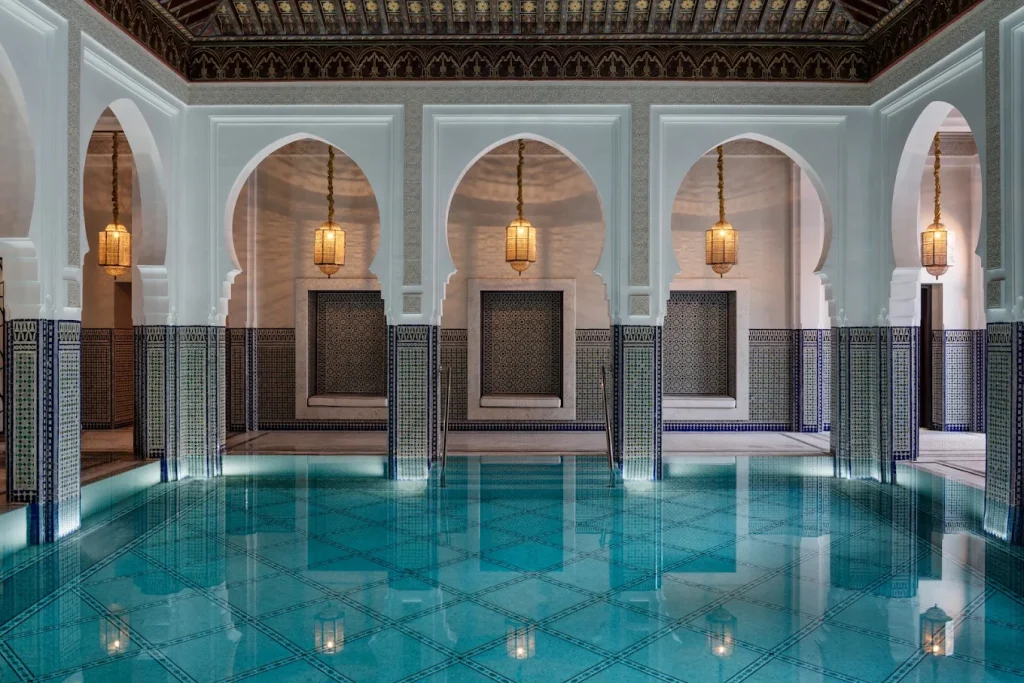
The Moroccan HammamA First Timer’s Guide to the Real Thing
The Moroccan hammam is the single most underrated experience in Morocco, and the one most travellers get wrong by booking a soft hotel version of it. A real Moroccan hammam is not a gentle spa treatment. It is hot, thorough, slightly startling the first time, and you will leave with skin you did not know you had. It is also the closest most visitors get to ordinary Moroccan life.
Here is what actually happens, what to bring, and how to choose between the three very different kinds of hammam you will be offered.
What Happens in a Moroccan Hammam, Step by Step
You start in a warm room and move into a hot, steam filled one, where you sit on a marble bench and let the heat open your pores for ten or fifteen minutes. Then comes savon beldi, a soft black soap made from crushed olives and olive oil, which is spread over you and left to sit for another five minutes. It smells green and slightly bitter and it does nothing dramatic on its own – it is preparing the skin.
Then the kessa. This is a coarse glove, and the attendant uses it with real force. Grey rolls of dead skin come off in visible quantity, which is either satisfying or alarming depending on your temperament. It is not painful, but it is not subtle either. Afterwards you are rinsed with buckets of warm water, coated in rhassoul, a mineral clay from the Moulouya valley that has been used here for a thousand years, rinsed again, and sent out to cool down with a glass of mint tea.
The neighbourhood hammam
Every Moroccan neighbourhood has one. Entry is a few dirhams, you bring your own soap and bucket, and the atmosphere is loud, social and entirely local. Separate hours or buildings for men and women.
The riad hammam
A private marble chamber inside your riad, booked by the hour, with an attendant who speaks some English or French. The full ritual without the cultural navigation.
The spa hammam
Hotel spas offer a softened version with treatment beds, oils and a gentler scrub. Pleasant, expensive, and not really a Moroccan hammam. Fine as a massage, disappointing as an experience.
A Moroccan hammam on your last morning
Skin is sensitive for a day afterwards and you will want to do nothing much. Book it early in the trip, ideally after a long travel day, not before a flight.
What to Bring and What to Wear
For a public hammam bring flip flops, a towel, a change of underwear, your own soap and a plastic bucket if you have one, though these can be bought at the door. Wear underwear or swimwear on the bottom half – nudity is not the custom in Morocco and will make everyone uncomfortable, including you. For a riad or spa hammam, everything is provided and disposable underwear is standard.
Do not shave or wax in the two days before a Moroccan hammam, and do not book a beach day for the two days after. The scrub removes a full layer of dead skin, which is exactly the point, and it leaves you noticeably more sensitive to sun and salt water than usual.
Why a Moroccan Hammam Is Worth Doing Properly
The Moroccan hammam survives in Morocco because it works and because it is social. Historically every mosque had one attached, heated by the same furnace – the neighbourhood hammam was where news travelled, marriages were arranged and children learned to swim in a bucket. Booking the hotel version misses all of that, and the hotel version is usually four times the price.
The Three Kinds of Moroccan Hammam and Which One You Want
People use one word for three quite different experiences, which is why so many first visits go wrong. The public hammam, the Moroccan hammam beldi, is a neighbourhood bathhouse where Moroccans go weekly. It costs a few dirhams, it is loud, it is scalding, and it is the real thing. The riad hammam is a small private steam room in your accommodation, booked by the hour, calm and entirely yours. The spa hammam is the hotel version: heated marble, a treatment menu, a therapist trained to a script, and a price that reflects all of it.
For a first hammam we send almost everybody to the riad version. You get the actual sequence, the black soap, the glove, the rinse, the rest, without having to read a room where nobody is speaking your language and the etiquette is unwritten. Once you have done it twice, the public hammam becomes a really wonderful hour, and we are happy to arrange a guide of the same gender to take you and stay with you. Doing it in that order is the difference between a story you tell warmly and one you tell as a warning.
What Actually Happens, Step by Step
Heat and stillness
You sit in steam for ten to fifteen minutes doing nothing at all. This is not the treatment, it is the preparation, and rushing it is why some people find the scrub uncomfortable. Warm water is poured over you from a bucket. You will sweat far more than you expect and that is the point.
Black soap
Savon beldi, a dark olive paste with eucalyptus, is spread over your whole body and left for five to ten minutes. It smells medicinal and softens the skin so the glove can work. Nothing is happening during this pause and nothing is supposed to. Lie down and let the heat do it.
The kessa glove
This is the part that surprises visitors. A coarse glove is used firmly, and grey rolls of dead skin come off in visible quantity. It is not painful but it is vigorous, and you can say aftik or simply lighter and the pressure will change immediately. Nobody will be offended.
Rinse, rhassoul, rest
Buckets of water, then often a rhassoul clay mask through the hair and over the body, then a final rinse and twenty minutes lying still with mint tea. Do not book anything for the hour afterwards. The rest is not an add on, it is half of why you feel the way you feel.
Etiquette, Modesty and Practical Questions
Hammams are single gender, always, with separate hours or separate rooms. You keep underwear on, and disposable briefs are provided in spa and riad settings. Nudity is not expected and is not appropriate in a public hammam. Bring or ask for flip flops because the floor is very hot, and a towel and a change of dry underwear because you will not want to put the wet pair back on. Leave jewellery in the room. Do not photograph anything inside a public hammam under any circumstances.
Skip the Moroccan hammam if you are pregnant without medical clearance, if you have a heart condition, if you are sunburnt, or if you have had waxing, laser or any facial treatment in the previous two days, because the glove on freshly treated skin is truly unpleasant. Do not book a Moroccan hammam on the same day you arrive from a long flight if you can help it, and do not book one on your first desert morning either. The best moment is the evening after a hard day of walking a medina, or the day you come back from the dunes with sand in absolutely everything.
In a public hammam the attendant who scrubs you is often paid only by you, so twenty to fifty dirhams handed over directly is right. In a riad or spa the treatment is billed and ten percent to the therapist is generous. Take small notes with you into the changing room because there is no card machine anywhere near the steam.
Where the Hammam Fits in an Itinerary
We build hammams into trips on purpose rather than leaving them as a maybe, and the placement is deliberate. Marrakech on the second evening, once the medina has been walked and the body knows it. Fes on the afternoon after the tanneries, because the contrast is perfect. The Atlas or the desert camp on the final night before the drive back, when you want to arrive home already reset. Two hammams in eight days is right for most people. Three is enjoyable. Four is more scrubbing than any skin needs.
Build a Moroccan Hammam Into Your Trip
Our women only journey includes a privately hired hammam with a traditional black soap and kessa ritual, an argan oil massage and a rhassoul clay treatment, in houses we have used for years.
See the Women Only Journey