Four Capitals, Nine Days,Eleven Centuries
Morocco has had four imperial capitals, and each one was built by a different dynasty that wanted to erase the last. This journey takes all four in the order the history happened, which is the only order in which any of it makes sense.
Marrakech was founded by the Almoravids in 1070 and rebuilt by the Almohads who destroyed them. Fes was founded earlier, in 789, and is where the scholarship went. Meknes was Moulay Ismail’s attempt in the 1670s to out-build Versailles with twenty thousand labourers. Rabat was a crusader staging post that became the modern capital in 1912. You can see all four in nine days without hurrying, because they sit on one road.
We add Volubilis because it explains the rest. It is the best preserved Roman city in Morocco, abandoned around the eighth century, and the mosaics are still in the floors where they were laid. Standing in it, the imperial cities stop looking ancient and start looking recent.
The driving is easy. Marrakech to Rabat is motorway, Rabat to Fes is motorway, and the longest single leg is under four hours. This is a journey about cities and the walking inside them rather than about distance.
One Road North,Four Capitals on It
The route runs south to north with no backtracking, so you fly into Marrakech and out of Casablanca and never drive a road twice.
What the Four CitiesEach Give You
They are not variations on one another. Each was built by people trying to be unlike the last, and the differences are the point.
Marrakech, the Southern Capital
Almoravid foundation, Almohad rebuilding, Saadian tombs and a souk that still works as a souk. Three nights because one is not enough and two always feels short.
Volubilis, the Roman Floor
A full Roman city on a hillside above the olive groves, with the House of Orpheus and the Dionysus mosaics still in place. Go late in the day when the stone turns and the tour buses have gone.
Meknes, the Overreach
Moulay Ismail built forty kilometres of walls, stables for twelve thousand horses and a granary engineered to stay cool without power. He died in 1727 and the city stopped. It is the most atmospheric of the four.
Fes el Bali, the Oldest
The largest car free urban area in the world and the oldest continuously operating university, founded in 859 by Fatima al Fihri. Two full nights, and a guide who can actually navigate nine thousand lanes.
The Hassan II Mosque
One of the few mosques in Morocco open to non Muslims, built out over the Atlantic with a 210 metre minaret and a retractable roof. The guided interior visit is included, not an upsell.
Rabat, the Working Capital
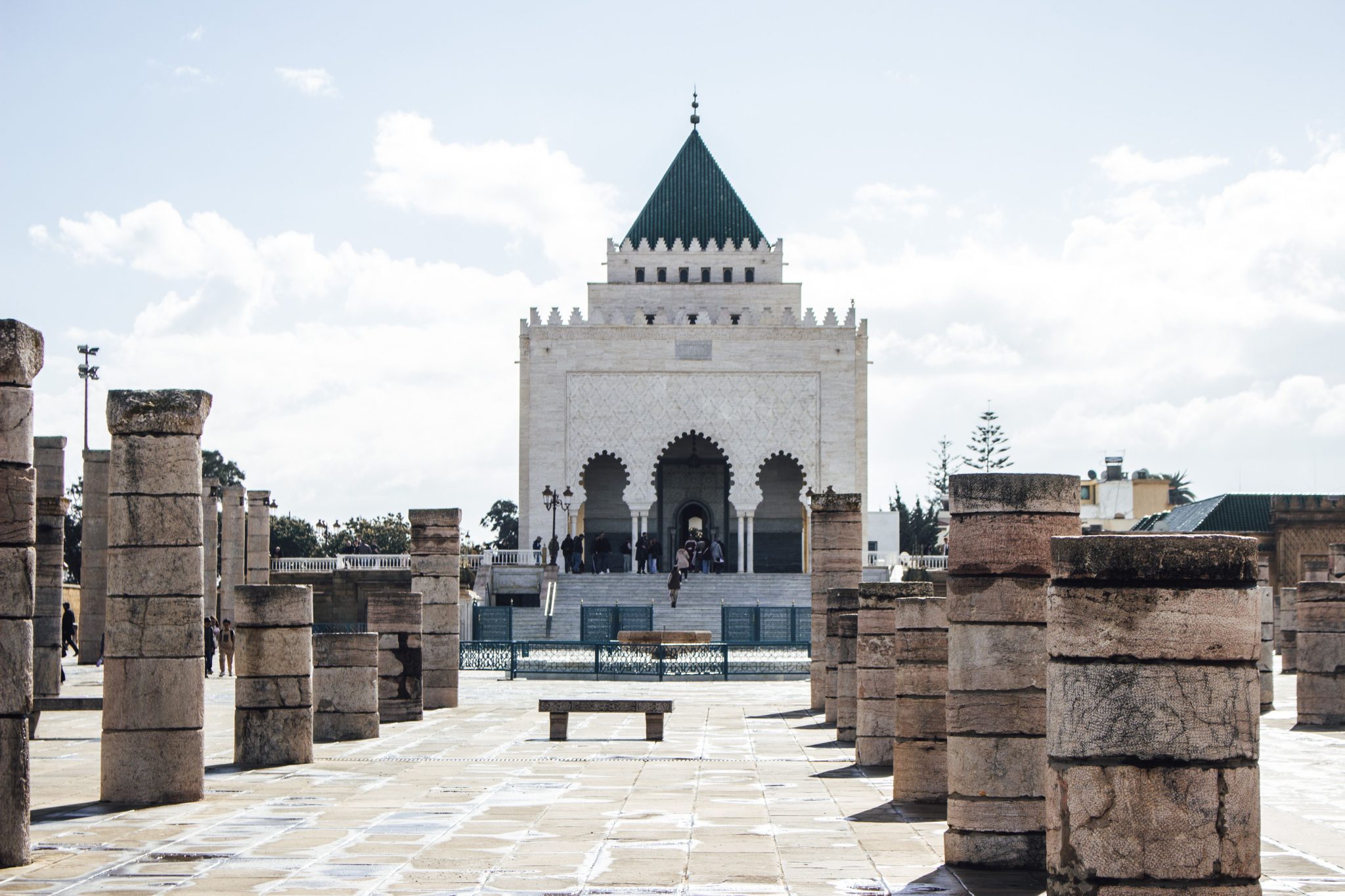
Kasbah des Oudayas above the river mouth, the unfinished Hassan Tower, the Chellah necropolis with storks nesting in the Roman ruins. The least visited of the four and the most liveable.
Nine Days AcrossFour Capitals
The real itinerary, with the real driving times and what happens between them. Open any day to see where you sleep and how you move.
Your driver meets you inside the terminal and the transfer to the medina takes about fifteen minutes. The last stretch is on foot through the derb, because cars do not reach most riads, and a porter takes the bags.
Nothing is scheduled. If you arrive early, mint tea on the roof and a first walk towards the Koutoubia, whose minaret is the one landmark you can navigate by from anywhere in the old city.
In the evening, Jemaa el Fna. The food stalls go up around six and the square becomes something between a market, a theatre and a kitchen. Eat at a numbered stall, not at a restaurant terrace with a view of the stalls.
A full day with a private guide, beginning at the Koutoubia while it is still cool. The minaret was finished around 1195 and became the model for the Giralda in Seville and the Hassan Tower you will see in Rabat on day four, which is the thread that holds this whole journey together.
The Bahia Palace in the late morning, built for a grand vizier who had been born a slave, then the Saadian Tombs, sealed in 1603 and lost until an aerial survey rediscovered them in 1917. Lunch in a courtyard, then the souks: the dyers, the coppersmiths, the carpet quarter.
In the afternoon, the Jardin Majorelle and the Berber Museum, or Le Jardin Secret inside the medina if you would rather not drive. Both are included; your guide will read the heat and the crowds and tell you which works better that day.
An early start if you want the balloon. Lift off is at first light over the Haouz plain with the Atlas on one side and the palm groves on the other, and you are back at the riad by mid morning for a second breakfast.
The cooking class runs late morning into lunch. You start at the market choosing what you are going to cook, then work in a riad kitchen with a dada, the Moroccan women who cook professionally in private houses. You eat what you made, which is usually better than it has any right to be.
The afternoon is deliberately empty. Most people use it for a hammam, which after two days of walking is the correct decision. We book it when you tell us you want it rather than in advance.
We leave after breakfast and take the A3 north across the Rehamna plain. It is the easiest driving of the journey and the landscape changes steadily from red earth to green coastal farmland.
Rabat in the afternoon with a local guide. The Kasbah des Oudayas first, a twelfth century fortress above the mouth of the Bou Regreg with an Andalusian garden inside and lanes painted blue and white, then the Hassan Tower, a minaret abandoned half built in 1199 when the sultan died, standing over two hundred unfinished columns.
If there is light left, the Chellah: a Roman town that became a Merinid necropolis, now half overgrown, with storks nesting on top of the minaret. It is the strangest and best thing in Rabat and almost nobody goes.
North east through Khemisset and into the Zerhoun hills, which are covered in olives and look more like Tuscany than anything else in Morocco.
Volubilis in the late morning. It was a Roman provincial capital of perhaps twenty thousand people, abandoned by the eighth century and quarried for Meknes in the seventeenth, which is why the arch still stands and the houses do not. The mosaics are in situ, uncovered, in the floors of the houses they were made for. The House of Orpheus and the Dionysus floor are the two to stand in front of properly.
Then Moulay Idriss, the hill town holding the tomb of the man who founded the Moroccan state, and down to Meknes for the night. Dinner on a terrace facing the Bab Mansour gate is the thing to do here.
The morning in Meknes. Moulay Ismail ruled for fifty five years and spent most of them building: forty kilometres of walls, the Heri es Souani granary with its vaulted chambers and underground water system, and stables said to have held twelve thousand horses. Much of it is roofless now after the 1755 Lisbon earthquake, which makes it better rather than worse.
Bab Mansour, finished in 1732, is the most elaborate gate in Morocco and its architect was reportedly executed for admitting he could have done better. The medina behind it is a working one with almost no tourism, which after Marrakech is a noticeable change of air.
An hour east to Fes in the afternoon, arriving with enough time to walk down into the medina before dinner and begin to understand the scale of what you are about to spend two days in.
Fes el Bali has around nine thousand lanes and no cars, and a guide here is not a luxury. Ours are from the city. We start at the Bou Inania Medersa, a fourteenth century Merinid college with carved cedar, stucco and zellige on every surface, and the water clock opposite that nobody has fully explained.
The Chouara tanneries in the late morning, from a terrace above, where hides have been worked in stone vats with pigeon droppings and lime since the eleventh century. You are handed mint to hold under your nose and you will need it. Then the Attarine Medersa, the Nejjarine fountain and the carpenters’ square.
Al Qarawiyyin in the afternoon, founded in 859 by Fatima al Fihri and recognised as the oldest continuously operating degree granting university in the world. Non Muslims cannot enter the prayer hall but you can see into the courtyard from several doorways, and the library next door has been restored and is extraordinary.
Motorway west through Meknes and Rabat to the coast. We time the arrival for the mosque, because the guided interior visits run at fixed hours and the last one is early.
The Hassan II Mosque was finished in 1993, holds twenty five thousand people inside and another eighty thousand on the terrace, and a third of it stands over the Atlantic. The minaret is 210 metres, the roof opens, the floor is heated, and the ablution hall in the basement with its lotus fountains is the part most visitors never get shown. Our guided visit includes it.
The rest of the afternoon in Casablanca: the Art Deco quarter around Boulevard Mohammed V, which is the best concentration of 1920s and 1930s architecture in Africa, and dinner somewhere on the corniche.
A transfer timed to your flight. Mohammed V is Morocco’s main international hub and the drive out is straightforward, but we build a margin because the check in queues can be long at peak hours.
If you have a late flight there is time for the Habous quarter, a 1920s French built neighbourhood in Moroccan style with the best bookshops and pastry in the city, or the Jewish Museum, which is the only one of its kind in the Arab world.
If you would rather keep going, this journey extends naturally north to Tangier and Chefchaouen, or south from Marrakech to the Sahara. Tell us and we will cost it on your dates.
Eight Nights,Five Cities
We name the exact property when we quote, because availability in the Marrakech and Fes medinas moves week to week. These are the categories we book and what each is actually like.
A traditional house around an open courtyard, six to twelve rooms, plunge pool below and breakfast on the roof. Inside the medina rather than in Gueliz, so you can walk out into the city rather than drive into it.
Rabat is a working capital rather than a tourist city, and its good hotels reflect that: comfortable, quiet, well run, with proper breakfast and an easy walk or short drive to the kasbah.
Meknes has fewer options than the other three and we choose for atmosphere: a restored house in the medina with a terrace facing the walls, or a quiet hotel on the edge of the old city.
The Fes riads are generally grander than the Marrakech ones, with higher ceilings and more carved cedar, because the merchant houses here were bigger. Expect to be met at a gate and walked in.
A final night chosen for a good bed, a good shower and a straightforward run to the airport. The corniche hotels put you near the mosque and the evening restaurants.
If you would rather upgrade, there are two or three genuinely luxurious houses in each of the Marrakech and Fes medinas, and a Four Seasons on the Casablanca corniche. Tell us the budget and we will show you what the difference actually buys.
What This JourneyActually Costs
We do not publish a single figure for this itinerary, because a number quoted without your dates is a number designed to be revised later. What follows is what genuinely moves the price.
Season is the biggest lever. April and October are the two best months in these cities and the good riads fill months ahead. July and August are cheaper because Marrakech and Fes are genuinely hot and most visitors go to the coast instead.
Group size matters more than people expect, because the vehicle, the driver and each city guide cost the same whether there are two of you or six. Four travelling together will each pay substantially less than two.
Send us your dates and how many of you there are and we will come back within 24 hours with a full costing, the exact properties, and what each upgrade is actually worth.
Indicative from prices, per person
Included in the price
- Private air conditioned vehicle and professional driver throughout
- All airport transfers in Marrakech and Casablanca
- Eight nights accommodation in the categories described above
- A private local guide in each city, not one guide for the whole trip
- Guided interior visit of the Hassan II Mosque in Casablanca
- All entrance fees to the monuments named in the itinerary
- Cooking class in Marrakech with a market visit
- Guided visit of Volubilis with a licensed site guide
- Breakfast daily
Not included
- International flights
- Travel insurance
- Meals not stated in the itinerary
- Tips and personal expenses
What to ExpectBefore You Commit
How Much Driving
Four travel days, none longer than three and a half hours, all of it on motorway or good national road. The rest of the time the car is parked and you are walking. This is the least driving of any of our multi region journeys.
How Much Walking
Three to five hours a day on uneven medina stone, in Fes with real gradients. Good shoes matter more than anything else you pack. If walking is difficult, tell us and we will restructure Fes around shorter loops with rest stops.
Travelling With Children
It works from about eight years old. Younger than that, the medina days are long and the monuments blur together. The balloon and the cooking class are the two things children reliably remember.
When Not to Go
Ramadan if you want the restaurants and souks at full tilt, though the evenings are extraordinary and some travellers prefer it. High summer, when Fes and Marrakech sit above forty degrees and the medinas empty out at midday.
What We Would Change
If you have eleven days instead of nine, add Chefchaouen between Fes and Casablanca rather than lengthening any city. If you have ten, add a second night in Meknes and do Volubilis properly at dawn.
Who Guides You
A different licensed local guide in each city, which is deliberate. A Marrakech guide in Fes is a visitor like you. The driver stays with you throughout and is the constant.
Imperial Cities QuestionsWe Are Asked Most Often
They Travelled With Us
Mohammed had the talent to make us approach beautiful sites, far from places a little too touristy. He tells us with passion, humor and knowledge about his beautiful country. A true storyteller.
My 2nd trek with Authentic Travel Tour [now Afsou Travels Morocco] and with Mohamed, this time at Toubkal. Mohamed is a great guide, kind, very professional and attentive to all. Everything is perfectly organized and the scenery is beautiful. I recommend 100%.
Many thanks to our wonderful guide Mohamed and all his team for this wonderful week. We will have wonderful memories for a long time thanks to their warm welcome, their dedicated commitment and their kindness.
The Good Riads in FesBook Months Ahead
Send us your dates and the number of you travelling, and we will come back within 24 hours with a fully costed version of this journey, the exact riads we would hold in each city, and what each upgrade honestly buys.