Eight Days From the Red Cityto the Far Dunes
Most Marrakech to Sahara trips sell you Erg Chebbi, nine hours each way on tarmac, with one night in a camp that has a car park. This one goes to Erg Chegaga instead, which is harder to reach and that is the whole point.
Chegaga is the larger of Morocco’s two great ergs, about forty kilometres of dunes running along the edge of the Iriqui basin, and the last stretch to it has no road at all. You reach it in a 4x4 across open hamada with your driver reading the ground rather than a sign. There are a handful of camps out there and no day trippers, because a day trip is not possible.
The route to it is the better route too. You cross the High Atlas at Tizi n’Tichka, stop properly at Aït Benhaddou rather than for twenty minutes, and then follow the Draa the length of its palm groves, which is the longest river in Morocco and for a hundred and fifty kilometres it is one continuous oasis. Two nights in the dunes at the far end, then back over the mountains by a different rhythm.
Everything is private. Your driver, your guide, your 4x4, your pace. If you want to stop at a roadside argan cooperative or sit for an hour in Aït Benhaddou after the coaches leave, you stop. Nothing on this itinerary is shared with strangers.
Five Stops, One Loop,No Backtracking
The journey runs south over the Atlas, down the Draa to the dunes, then back by the Ouarzazate side, so you never drive the same road twice.
What Eight Days BuysThat Four Days Cannot
The short desert trips exist because they fit a long weekend. These are the six things that only appear once you give the route the time it needs.
Erg Chegaga, Not Erg Chebbi
Chebbi is the dune field most tours use because a tarmac road runs to the edge of it and coaches can park. Chegaga is reached only by 4x4 across open ground, which keeps the numbers down. Standing on the high crest at dawn, there is nothing manmade in any direction.
Two Nights in the Dunes
One desert night is an arrival and a departure. Two gives you a full day out there, which is when the place stops being a photograph and starts being somewhere you are. The second morning is the one people remember.
Aït Benhaddou Without the Queue
We time the ksar for late afternoon, after the day groups have gone back to Marrakech. You climb to the agadir at the top with the light going long and the Ounila valley turning gold behind you.
The Whole Draa Valley
Most itineraries cut across to the desert and skip the Draa. We drive it, from Agdz to Zagora, through a palm grove that runs almost unbroken for a hundred and fifty kilometres past kasbahs that are still lived in.
A Guide Who Is From Here
Our guides are Amazigh, from the south, and most of them have family along this route. That is the difference between being told about a kasbah and being taken into one.
Private 4x4 Throughout
One vehicle, one driver, the whole way. No transfers between minibuses at Ouarzazate, no waiting for a group to reassemble, no fixed departure time in the morning.
Eight Days, ToldHour by Hour
The real itinerary, with the real driving times and what actually happens between them. Open any day to see where you sleep and how you move.
Your driver meets you inside the terminal, not at the kerb, and the transfer into the medina takes about fifteen minutes. Cars cannot reach most riads, so the last two hundred metres are on foot through the derb with a porter for the bags. It is the correct introduction to a city that is built around that fact.
The rest of the day is yours. If you land early there is time for mint tea on the roof and an hour of getting lost deliberately, which is the only way the medina ever starts making sense. If you land late, go straight out to Jemaa el Fna after dark, when the food stalls are up and the square is doing what it has done since the eleventh century.
We do not schedule anything on arrival day. Flights slip, and the first evening is better spent adjusting than performing.
A full day with a private local guide, starting early while the souks are still being opened and the light is coming down into the alleys at an angle. We begin at the Koutoubia, whose minaret set the proportions for the Giralda in Seville and the Hassan Tower in Rabat, then go into the covered souks by the dyers’ quarter rather than the tourist entrance.
The Bahia Palace in the late morning, built in the 1860s by a grand vizier who had been a slave, and then the Saadian Tombs, which were sealed up in 1603 and not reopened until an aerial survey found them in 1917. In the afternoon, Le Jardin Secret or the Majorelle and the Berber Museum, depending on how much walking you want and how hot it is.
We leave the end of the day open on purpose. Most people want a hammam by then, and the good ones need booking the same morning once we know how you are feeling.
We leave after breakfast and climb the Tizi n’Tichka, the pass that crosses the High Atlas at 2,260 metres. The road was rebuilt and widened over the last few years, which has taken an hour off this leg and most of the drama out of it. There are two or three places worth stopping on the way up, and your driver knows which of them are viewpoints and which are shops pretending to be viewpoints.
Aït Benhaddou in the afternoon. The ksar is a UNESCO site and the most filmed building in Morocco, and in the middle of the day it is busy. By four o’clock the coaches have gone and you can cross the river, walk up through the earthen houses and climb to the agadir on the summit with the valley opening out below. Eight families still live inside the walls.
Then Ouarzazate, and south through Agdz into the Draa. The valley starts suddenly, a green line in a brown country, and you follow it with the palms on one side and the escarpment on the other until Zagora. You arrive in the early evening with enough light to see where you are.
A short morning along the last of the Draa to M’Hamid, which is where the tarmac ends and Morocco runs out of road. From there it is open desert, about two hours of hamada and dry riverbed with your driver navigating by landform. You pass the odd nomad camp and a well or two and then the dunes come up on the horizon like weather.
Erg Chegaga is roughly forty kilometres long and up to three hundred metres high in places, and because there is no road to it there are no day visitors. You arrive at the camp in the afternoon, which leaves time to do nothing for an hour before the heat goes out of the day.
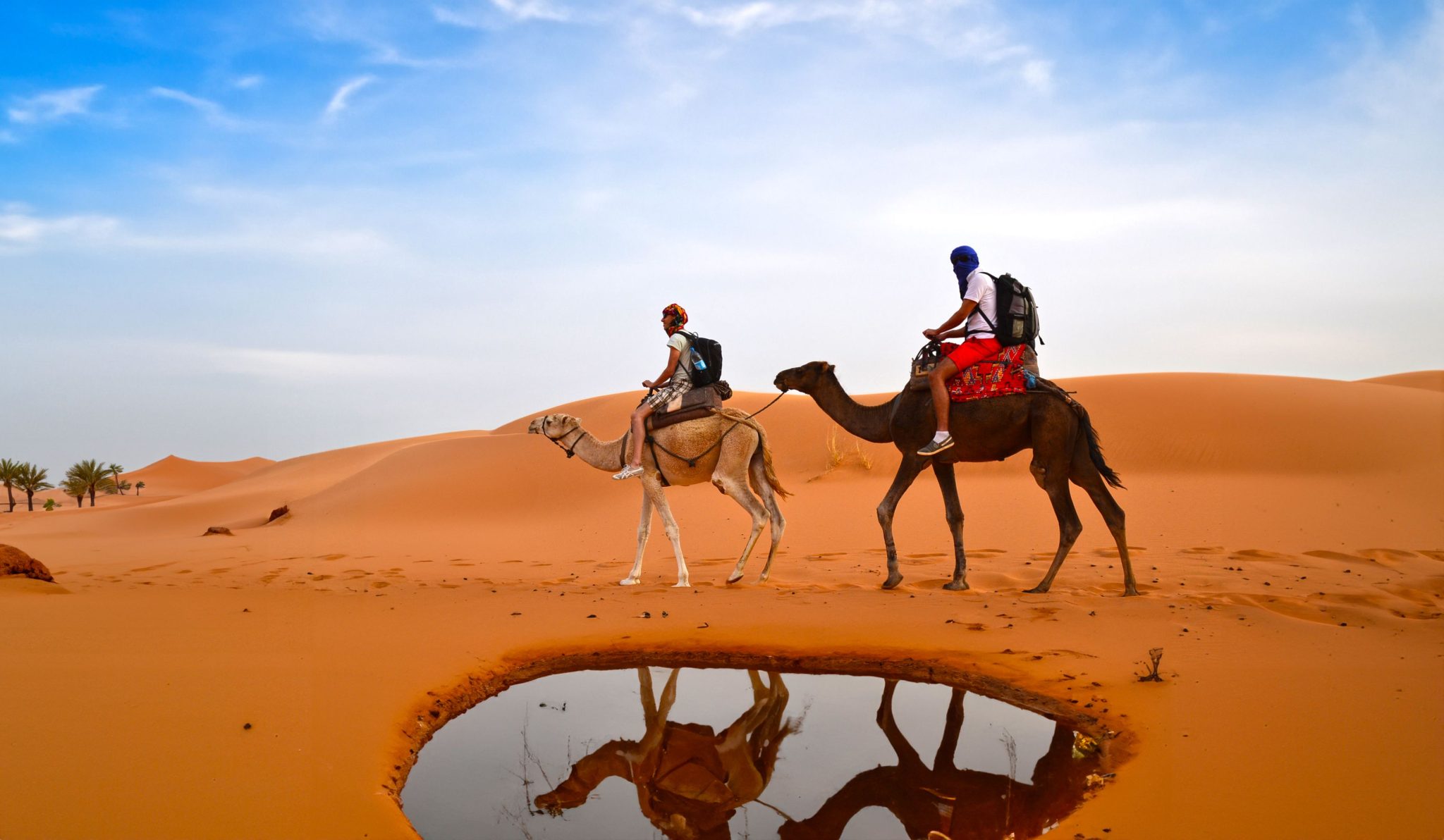
At about an hour before sunset you go out on camels into the dunes to a high crest, and the guide brings tea. The sun goes down fast at this latitude. Dinner is back at the camp, and afterwards the generator goes off and the sky does the thing that everybody comes here for.
This is the day that makes the journey worth eight days instead of four. Nothing is compulsory. Most people start before sunrise, walking twenty minutes up the nearest high dune in the cold to watch the light arrive, then come back down for breakfast as the camp wakes up.
Through the morning we take you out to a nomad family who still move with their herds in this area, which is a genuine visit rather than a staged one, and then on to the edge of Lake Iriqui, a dry lake bed that fills only in exceptional years and held water again in 2024 for the first time in half a century. Sandboarding in the afternoon if you want it, and a long lunch and a sleep if you do not.
In the late afternoon there is a second camel ride for those who want one, or a walk out into the erg on foot, which is better for photographs. The second night in the desert is always more relaxed than the first, because by then you have stopped checking your phone for a signal that is not coming.
Out across the hamada in the early morning while it is still cool, back to the tarmac at M’Hamid, and then north up the Draa by the same valley you came down, which looks entirely different going the other way with the light on the other side of the palms.
We stop at Tamegroute, where there is a Koranic library holding manuscripts from the eleventh century and a pottery quarter working in a green glaze made with manganese that is found nowhere else in Morocco. The kilns are underground and still fired with palm fronds.
Ouarzazate in the late afternoon. If the Atlas Studios appeal you can visit them, or the Taourirt Kasbah in the centre of town, which was the Glaoui stronghold and is the better building of the two. A proper shower and a bed after two nights under canvas is not to be underestimated.
A relaxed start. The drive back crosses the Tichka again, and because you are going north the views open the other way, down over the Haouz plain towards Marrakech with the mountains behind you.
If you want one more stop, the old Telouet Kasbah is a half hour detour off the pass and almost nobody goes there. It was the seat of the Glaoui family who effectively ran southern Morocco until 1956, and it is half ruined and completely unrestored, with two or three rooms of extraordinary painted cedar and zellige still intact under a collapsing roof.
You are back in Marrakech by mid afternoon, which leaves the evening free for whatever you did not get to on day two. Most people use it for the souks, now that they know their way around.
Breakfast on the roof and a transfer timed to your flight. The airport is close and the formalities are usually quick, but we build in a margin because the queues at Menara are unpredictable in high season.
If you have a late flight, we can hold a day room at the riad or arrange a last morning with your guide, in the Mellah and the spice souk, or at the tanneries, which almost nobody sees in Marrakech because everybody is told to see them in Fes.
If you would rather carry on than go home, this itinerary joins naturally to Essaouira on the coast, which is three hours west, or to the Dades and Todra gorges if you want more mountains.
Seven Nights,Four Kinds of Room
We name the exact property when we quote, because availability in the medina and at the Chegaga camps moves week to week. These are the categories we book and what each one is actually like.
A traditional house built around an open courtyard, usually six to twelve rooms, with a plunge pool at the bottom and breakfast on the roof. We book inside the medina rather than in Gueliz, because the whole point of Marrakech is being able to walk out of your door into it. Cars cannot reach the door; that is normal and the porters handle it.
A single night, so the brief is simple: quiet, clean, a pool, and dinner that is worth sitting down to after six hours in the car. The better places here are built in the local pisé style with thick walls and courtyards, on the palm grove side of town rather than the main road.
Not the nylon camps you see nearer the tarmac. Proper walled tents with a real bed, a private bathroom with running water and a hot shower, rugs on the sand floor and a canvas door you can close. Solar power, a generator for a few hours after dinner, and then silence. There are perhaps a dozen camps across the whole erg and we use two of them.
Ouarzazate is a staging post rather than a destination, so we choose for comfort and a good shower rather than character. Most of what we use has a pool and a terrace facing the mountains, which after the desert is exactly what the evening calls for.
If you would rather upgrade, there are two or three genuinely luxurious options in the Marrakech medina and one camp at Chegaga with suites and a heated pool. Tell us the budget and we will show you what the difference actually buys rather than what the brochure says it buys.
What This JourneyActually Costs
We do not publish a single figure for this itinerary, because a number quoted without your dates is a number designed to be revised later. What follows is what genuinely moves the price.
The two biggest levers are the season and the camp. A week in late March costs noticeably more than the same week in late June, because March is the best month here and the camps fill. A suite tent with a heated pool at Chegaga is a different proposition from a standard tent, and both are good.
Group size matters more than people expect, because the 4x4, the driver and the guide are the same cost whether there are two of you or six. Four travellers sharing the vehicle will each pay substantially less than two.
Send us your dates and how many of you there are and we will come back within 24 hours with a full costing, the exact properties, and what each upgrade is actually worth.
Indicative from prices, per person
Included in the price
- Private 4x4 and professional driver for the whole journey
- All airport transfers in Marrakech
- Seven nights accommodation in the categories described above
- Two nights in a tented camp at Erg Chegaga, full board
- Camel trek at sunset on arrival in the desert
- Experienced private Amazigh guide throughout
- Full day private guided tour of Marrakech
- Nomad family visit and Lake Iriqui excursion at Chegaga
- Breakfast daily, plus all meals in the desert
Not included
- International flights
- Travel insurance
- Lunches and dinners outside the desert, unless stated
- Monument entrance fees in Marrakech
- Tips and personal expenses
What to ExpectBefore You Commit
How Much Driving
Two long days and five easy ones. Marrakech to Zagora is the big one at about six hours with stops, and Erg Chegaga back to Ouarzazate is about five. Everything else is under four. If that is too much, we can add a night in the Draa and split the first leg.
How Hard Is the Desert
Not hard at all. The camel ride is about forty minutes and entirely optional; you can walk or take the 4x4 instead. The camp has beds, bathrooms and hot water. The only genuine discomfort is the cold at night between November and February, and a fleece solves it.
Travelling With Children
This route works well from about six years old. The long drive on day three is the limiting factor rather than the desert, which children generally love. We can break it with a night in Ouarzazate, and the camps are relaxed about early dinners.
When Not to Go
July and August. Temperatures at Chegaga regularly pass 45 degrees and the camps that stay open are not pleasant. June and September are hot but manageable. The journey is at its best from October to April.
What We Would Change
If you have ten days rather than eight, add Essaouira at the end rather than a third Marrakech night. If you have nine, add the Dades and Todra gorges on the way back from Ouarzazate instead of driving straight to Marrakech.
Who Guides You
An Amazigh guide from the south, bilingual, with the national licence. The same person is with you from Marrakech to the dunes and back. We do not hand you between regional guides at Ouarzazate, which is what the cheaper operators do.
Marrakech and Sahara QuestionsWe Are Asked Most Often
They Travelled With Us
Mohammed had the talent to make us approach beautiful sites, far from places a little too touristy. He tells us with passion, humor and knowledge about his beautiful country. A true storyteller.
A 3rd unforgettable experience in the Moroccan desert! Mohamed is a very professional guide who knows how to adapt to the group and remains attentive to the needs of each with kindness.
The five day ascent of Mount Toubkal was a real dive into the heart of the Atlas and its communities. Accompanied by Mohamed, his muleteers and his cook, we lived a total immersion in this region with respect for all.
The Good Camps at ChegagaFill First
Send us your dates and the number of you travelling, and we will come back within 24 hours with a fully costed version of this journey, the exact riad and camp we would hold, and what each upgrade honestly buys.