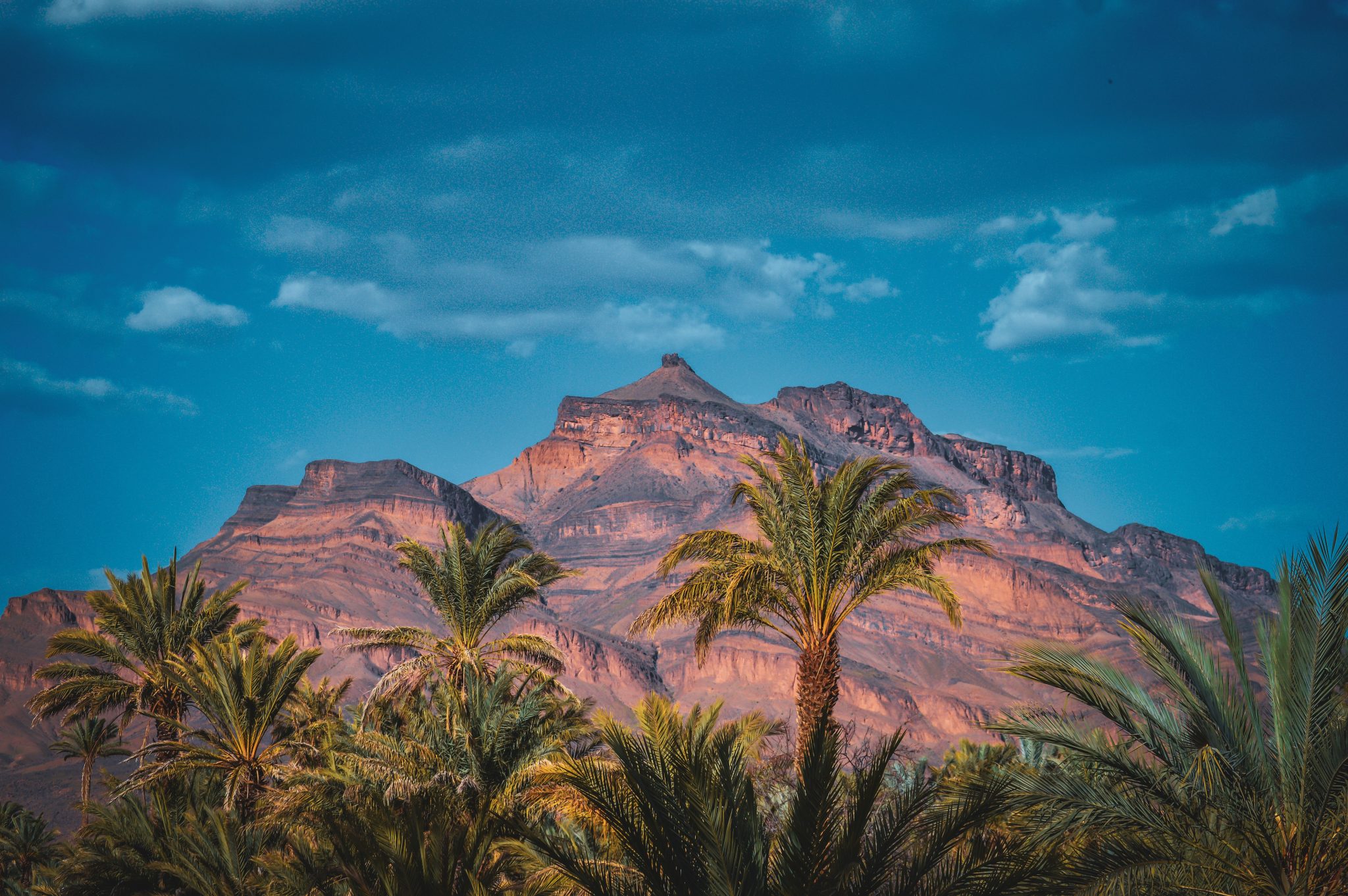
Where the Atlas Endsand the Desert Begins
The Jbel Saghro is the last range before the Sahara, a wind carved volcanic country of black mesas, rock spires and dry gorges, still used in winter by the Ait Atta, who are among the last genuinely nomadic people in Morocco.
This is the other winter trek, and the harder of the two. Where Tafraout is gentle and green, Saghro is stark: very little water, almost no villages, and a landscape that looks more like Arizona or the Hoggar than anything else in the country.
It is also where the Ait Atta spend the cold months. They come down from the High Atlas in October with their flocks and camp in the Saghro until spring, and on this route you will meet them, drink tea in their tents and camp near them. That is not a scheduled cultural visit; it is simply who is there.
The high point is Kouaouch at 2,592 metres, and the signature sight is Bab n’Ali, a pair of enormous eroded rock towers standing in the middle of a dry plain like a gate to nowhere.
Across the Saghroto the Draa
East to west across the massif from Tagdilte, over Kouaouch and past Bab n’Ali, finishing on the edge of the Draa valley.
Why SaghroIs Not Like the Atlas
Six things this trek has that none of our High Atlas routes can offer.
The Ait Atta in Winter
One of the last transhumant peoples in Morocco, who winter in the Saghro with their flocks. You will meet them on the trail and near the camps. Tea in a nomad tent here is not arranged; it is offered.
Bab n’Ali
Two enormous eroded volcanic towers standing alone on a plain, the most photographed thing in the Saghro and still almost unvisited. We camp close enough to walk there at first light.
A Winter Route
October to April, when the High Atlas is snowbound. Saghro is dry and clear in those months and the light in the low winter sun on black rock is the reason photographers come.
No Villages for Days
Three to four days with no settlement at all. This is the emptiest of all our treks and the one that feels furthest from anywhere.
The Edge of the Sahara
The trek finishes looking down at the Draa valley and the beginning of the desert. You can see where the mountains stop, which is a thing you rarely get to see so precisely.
Full Mule Support
You carry a day pack. Mules take the bags, the tents, the kitchen and, on this route, a good deal of the water. Without that support this would be a serious expedition rather than a trek.
Eight Days BetweenMountain and Desert
The real itinerary, with the real walking times. Open any day to see where you sleep and how far you walk.
Your driver meets you at the airport and takes you to a riad in the medina. The afternoon is free.
Your guide comes by in the evening to go through the route and check kit. On this trek the kit check matters more than usual, because the nights are cold and there is nowhere to buy anything after tomorrow.
Eat well. The cooking on the trail is good but it is cooked on a gas ring a long way from a market.
A long driving day over the Tizi n’Tichka and down through Ouarzazate, with a stop at Ait Benhaddou if the timing works. The landscape dries out steadily as you go south and east.
Past Skoura and Boumalne Dades, then up a side road onto the northern edge of the Saghro to Tagdilte, a village on a bare plateau that exists mainly as the gateway to the massif.
You sleep in a village house. The mules and the muleteers meet you here in the morning.
The walking starts on open plateau with very little cover, climbing gradually south into the massif. The ground is black volcanic rock and the horizon is enormous.
By midday you are among the first mesas and the path begins to wind between them. In winter this is where you start meeting Ait Atta camps, dark tents woven from goat hair with flocks spread out around them.
Camp at Almou n’Ouareg, a grazing area with a spring, which in this country is what determines where anyone camps at all.
Up Kouaouch in the morning, the highest point of the Saghro at 2,592 metres. It is a walk rather than a climb and the summit is a broad stony dome.
The view is the reason for the day: the whole Saghro below you, the High Atlas as a white wall to the north in winter, and to the south the Draa and the beginning of the Sahara. On a clear morning you can see three distinct worlds at once.
Down the south side and on to Igli for the night, camping among rock formations that look increasingly unlikely as you go.
Through the gorges towards Bab n’Ali, which means the gate of Ali: two colossal eroded towers of volcanic rock standing on a bare plain with nothing around them for scale until you walk up to the base.
We time the arrival for the afternoon light and camp close enough to go back at dawn, which is when the towers are at their best and when nobody else is there, because almost nobody else is ever there.
On to Amguis for the night, in a gorge where there is water and a little greenery, which after two days of black rock registers as luxury.
Down the Amguis gorge, which narrows in places to a corridor between walls and then opens again into wide dry plains.
The country softens slightly here, with tamarisk and the occasional palm, and there are old irrigation terraces where villages once stood and no longer do.
Camp at Tifrite, the last night under canvas, with the Draa valley now visibly closer and the air noticeably warmer than on the plateau.
A short last walk out to the road at the edge of the Draa valley, where the vehicle is waiting and the muleteers turn around and walk back.
Lunch in the palm groves of the Draa, which after a week of dry rock is a genuine shock of green, and then the long drive north through Ouarzazate and over the Tichka.
Marrakech in the evening. A hot shower, a proper bed, and a city that will feel extremely loud for about an hour.
Breakfast on the roof and a transfer timed to your flight, with a margin for the queues at Menara.
If your flight is late we can hold a day room, or arrange a last morning in the souks with a guide.
If you would rather keep going, the Saghro sits next door to the Dades and Todra gorges and is two days from Erg Chegaga, both of which make a natural continuation rather than a new trip.
Seven Nights,Mostly Under Canvas
The Saghro has almost no villages, so this trek camps more than any of our others. Here is exactly what each night is.
A courtyard house in the old city with a plunge pool and a roof terrace. The night before is for sleep and the kit check; the night after is for a long shower and a proper dinner.
A simple family house on the plateau. Mattresses, blankets, a shared bathroom and dinner cooked by the family. The last roof until the end of the week.
Two person mountain tents pitched by the mule team, foam mats, a mess tent and a cook. Washing is a bowl of hot water, the toilet is a shovel and a discreet distance, and the night sky is as good as any on earth.
If you would rather not sleep in a shared dormitory or a bivouac, we can run the whole trek on private tents with the mule team. It is more comfortable and it costs more, and we will price both so you can choose.
What This TrekActually Costs
Group size is the single biggest factor on a trek, because the guide, the cook and the mule team cost the same for two walkers as for eight. The figures below are indicative starting points, confirmed against your dates.
The prices below assume the standard sleeping arrangement described above, two nights in a Marrakech riad and everything in the included list. They move with the season only modestly: trek logistics do not fluctuate the way hotel rates do.
What does move the number is how many of you there are. Two walkers trekking privately carry the whole cost of a guide, a cook and a mule team between them. At four it drops sharply, and at six it drops again.
Send us your dates and the number of you walking and we will come back within 24 hours with a firm costing, the sleeping arrangement we recommend for that time of year, and an honest view of the conditions you should expect.
Indicative from prices, per person
Included in the price
- Certified Amazigh mountain guide with the national licence, throughout
- Muleteer, cook and mules carrying all luggage, kitchen, camp and water reserve
- All transfers between Marrakech and the trailheads, over the Tichka
- Two nights in a Marrakech riad, before and after
- Five nights on the trek in a village gite and wild camps
- All meals from day 2 dinner to day 7 lunch
- Tents, foam mats and mess tent
- Group safety kit and a first aid kit
Not included
- International flights
- Travel insurance, which must cover trekking to the altitude of this route
- Meals in Marrakech
- Sleeping bag hire, if you need one
- Tips for the guide, cook and muleteers
What to ExpectBefore You Commit
How Hard Is It
Moderate walking, hard conditions. Five to seven hours a day on rough volcanic ground, no altitude problems, but four nights camping in genuine cold with no facilities. The difficulty is comfort rather than fitness.
How Cold Does It Get
Below freezing at night from December to February, and fifteen to twenty degrees by day. A four season bag and a down jacket are not optional on this route.
Will We Really Meet Nomads
In winter, yes, almost certainly. The Ait Atta bring their flocks down into the Saghro from October to April and camp near the springs, which is where the route goes. In summer they are back in the High Atlas and the Saghro is empty and too hot.
What About Water
Dry country. All water comes from known springs, is treated by the team, and the mules carry a reserve. You will not be short, but you cannot be casual about it either.
What Do I Carry
A day pack only. Everything else goes on a mule. Bags should be soft rather than hard shell and under fifteen kilos.
How Does It Compare to Tafraout
Harder and emptier. Tafraout has villages, gentler days and almond blossom. Saghro has four nights of wild camping, nomads and a landscape that looks like nowhere else in Morocco. Both are winter routes; choose by how much comfort you want.
Saghro Trek QuestionsWe Are Asked Most Often
They Travelled With Us
My 2nd trek with Authentic Travel Tour [now Afsou Travels Morocco] and with Mohamed, this time at Toubkal. Mohamed is a great guide, kind, very professional and attentive to all. Everything is perfectly organized and the scenery is beautiful. I recommend 100%.
We did a 6 day Trek to Toubkal with Mohamed. That was really great. Mohamed is an excellent guide and he bent over backwards so that everything went well for the whole group of 16 people. I highly recommend.
Super Trek away from the roads that took us through authentic Berber villages with sublime scenery, great organization and tasty, excellent and abundant traditional local cuisine. Many thanks to Mohamed and all his team.
February and March in the SaghroAre the Ones to Book
Send us your dates and the number of you walking, and we will come back within 24 hours with a fully costed version of this trek, the sleeping arrangement we recommend and an honest view of the conditions.