A Dead Volcano BetweenTwo Mountain Ranges
Jbel Siroua is the only volcano in Morocco, a 3,305 metre massif standing alone in the gap between the High Atlas and the Anti Atlas. It belongs to neither range, looks like neither, and almost nobody walks it.
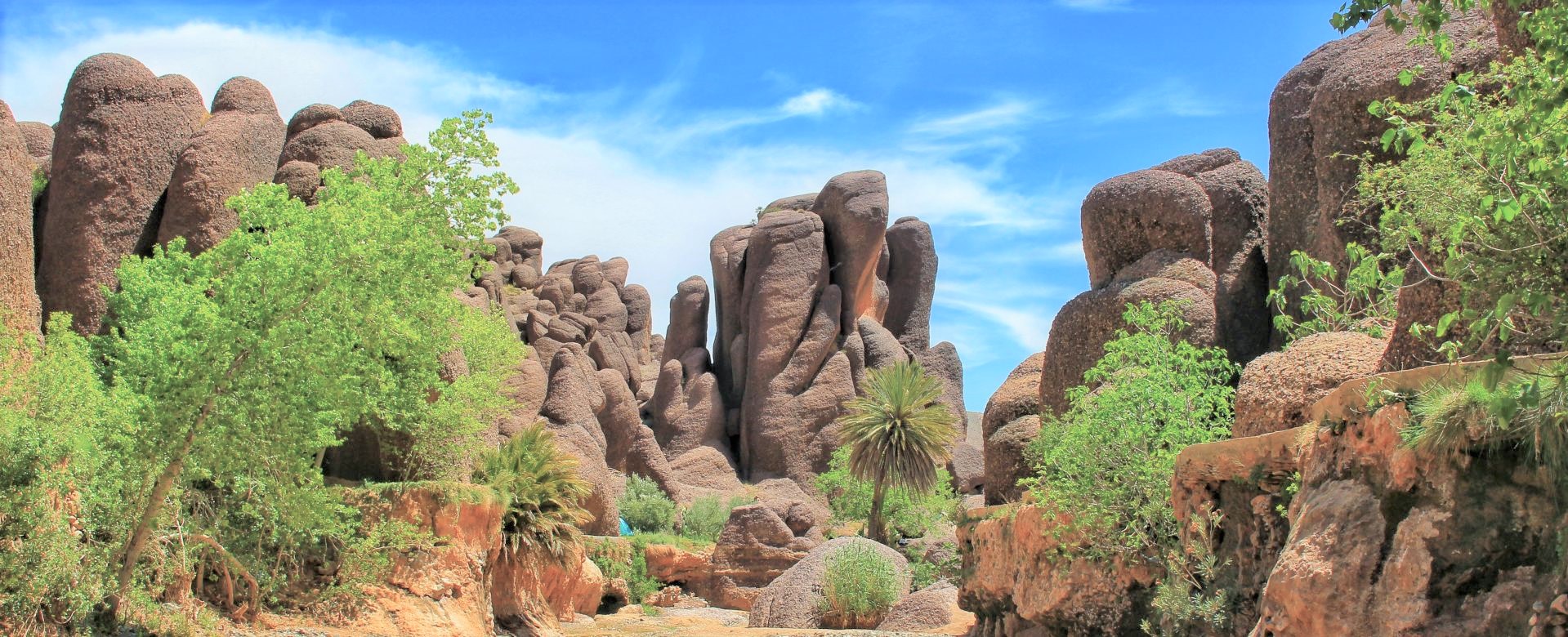
The rock here is basalt and rhyolite rather than the limestone and schist of the Atlas, which gives the whole massif a different character: black towers, red screes, lava flows frozen mid movement and a summit that is a volcanic plug rather than a peak.
The approach runs through the saffron country around Taliouine, which produces most of Morocco’s crop and harvests it by hand in late October and early November. If you walk this route in autumn you will cross fields of purple crocus at dawn with the pickers already out.
Six nights of walking, most of them under canvas, through villages that see very few outsiders. Mules carry everything, a cook travels with the group, and the guide is from the region.
In Over the Test Pass,Out Over the Tichka
Every journey is quoted individually, because what it costs depends on your dates, the size of your group and the standard of room you want. Tell us those three things and a full, itemised quotation comes back within 24 hours, with no obligation.
Why SirouaIs Worth the Detour
Six reasons to choose the volcano over the better known Atlas routes.
Morocco’s Only Volcano
Siroua is volcanic and the Atlas is not, which means the walking looks and feels unlike anything else in the country. Black basalt towers, red scree, and a summit plug you climb rather than a ridge you follow.
Saffron Country
The massif sits above Taliouine, which grows most of Morocco’s saffron. Late October and early November put you in the fields during the harvest, which is done at dawn by hand before the flowers open.
Genuine Emptiness
Toubkal has refuges and crowds. M’Goun has shepherds. Siroua has almost nobody. You will camp most nights with no other group within a day’s walk.
Lower and Kinder Than Toubkal
At 3,305 metres the altitude is far less punishing than the 4,000 metre routes, which makes this a good first Moroccan trek for walkers who are fit but have never been high.
Two Great Passes by Road
You enter over the Tizi n’Test, the old and spectacular road south from Marrakech, and leave over the Tizi n’Tichka. Those two drives are worth something in themselves.
Full Mule Support
You carry a day pack. Mules take the bags, the tents and the kitchen, and a cook travels with the group. Wild camping without that support would be a different proposition entirely.
Eight Days Acrossa Dead Volcano
The real itinerary, with the real walking times and heights. Open any day to see where you sleep and how far you climb.
Your driver meets you at the airport and takes you to a riad in the medina. The afternoon is free.
Your guide comes by in the evening to go through the route, check kit and answer questions. Anything missing can be bought tomorrow morning.
Eat well. The cooking on this trek is good but it is cooked on a gas ring at three thousand metres.
South out of Marrakech and over the Tizi n’Test, the old French built road that crosses the High Atlas at 2,100 metres with a drop on one side and almost no barrier. It is slower and far better than the Tichka, and we stop at the Tin Mal mosque on the way, an Almohad building of 1156 standing alone in the valley.
Down the far side into the Souss and east towards Taliouine, with the Siroua massif coming into view ahead as a dark mass quite separate from the Atlas behind you.
The mules meet you at the roadhead for an hour or two of easy walking to Tislit, where you sleep in a village house and eat with the family.
The walking begins properly. The path climbs out of Tislit through almond terraces and juniper into increasingly volcanic country, with the first black basalt outcrops appearing as you gain height.
You pass azibs, the stone shelters shepherds use in summer, and the villages thin out to nothing. The water comes from springs and the guide knows every one of them.
Camp at Azib Tizgui, the tents pitched by the mule team while there is still light and the cook already working. It is cold once the sun goes and the sky at this altitude with no town for fifty kilometres is the reason to be here.
A full day crossing the shoulder of Jbel Guiliz at around 2,900 metres, which is both a superb viewpoint and your acclimatisation for tomorrow. From the top the whole Siroua plug is visible for the first time, a tower of rock standing clear of everything around it.
The descent runs through lava fields, where the rock has set in ropes and folds and the colour shifts from black to rust to pale grey within a few hundred metres.
Camp at Azib Tagrara below the summit. An early night, because tomorrow starts in the dark.
Up before dawn and onto the mountain as the light arrives. The approach is a long steady climb across scree to the base of the summit plug.
The final section is the one part of this trek where you will use your hands: a short scramble up the volcanic rock to the top at 3,305 metres. It is straightforward in dry conditions and your guide will rope the group if there is ice. From the summit you see the High Atlas to the north, the Anti Atlas to the south, and on a clear day the Toubkal massif and the edge of the Sahara in the same turn of the head.
Down the far side and on to the camp at Tiswitine for a long afternoon of doing nothing.
Down off the massif through gorges and terraced fields, with the almond and walnut starting again as you lose height and the air thickening with every hour.
The villages here are built in pisé the colour of the hillside and the people in them see very few walkers. Your guide will know several of them by name.
Tizouade in the afternoon, a bed, a wash and a dinner cooked by the house rather than on the trail.
A last short walk down to the road where the vehicle is waiting, and goodbyes to the muleteers, who turn around and walk back the way you came.
North over the Tizi n’Tichka, the higher and busier of the two Atlas passes, with Ouarzazate country behind you and the Haouz plain opening ahead.
Marrakech in the late afternoon. A hot shower after six days is a specific and underrated pleasure. Most people want a hammam, which we book when you ask.
Breakfast on the roof and a transfer timed to your flight, with a margin for the queues at Menara.
If your flight is late we can hold a day room, or arrange a last morning in the souks with a guide.
If you would rather keep going, Siroua joins well to the Sahara at Erg Chegaga, or to Taroudant and the coast at Agadir, both of which are closer from here than from Marrakech.
Seven Nights,Mostly Under Canvas
This trek wild camps more than our others, because there are very few villages on the massif. Here is exactly what each night is.
A courtyard house in the old city with a plunge pool and a roof terrace. The night before is for sleep and the kit check; the night after is for a long shower.
Family houses in working villages. Simple rooms, mattresses and blankets, shared bathroom, usually hot water. You eat with the family and the cooking is very good.
Two person mountain tents pitched by the mule team, foam mats, a mess tent and a cook. No facilities beyond what the mules carry: washing is a bowl of hot water and the toilet is a shovel and a discreet distance.
If you would rather not sleep in a shared dormitory or a bivouac, we can run the whole trek on private tents with the mule team. It is more comfortable and it costs more, and we will price both so you can choose.
What This TrekActually Includes
Group size is the single biggest factor on a trek, because the guide, the cook and the mule team cost the same for two walkers as for eight. The figures below are indicative starting points, confirmed against your dates.
The prices below assume the standard sleeping arrangement described above, two nights in a Marrakech riad and everything in the included list. They move with the season only modestly: trek logistics do not fluctuate the way hotel rates do.
What does move the number is how many of you there are. Two walkers trekking privately carry the whole cost of a guide, a cook and a mule team between them. At four it drops sharply, and at six it drops again.
Send us your dates and the number of you walking and we will come back within 24 hours with a firm costing, the sleeping arrangement we recommend for that time of year, and an honest view of the conditions you should expect.
Included in the price
- Certified Amazigh mountain guide with the national licence, throughout
- Muleteer, cook and mules carrying all luggage, kitchen and camp
- All transfers between Marrakech and the trailheads, over both Atlas passes
- Two nights in a Marrakech riad, before and after
- Five nights on the trek in village gites and wild camps
- All meals from day 2 lunch to day 7 breakfast
- Tents, foam mats and mess tent
- Group safety kit, including a first aid kit and oximeter
Not included
- International flights
- Travel insurance, which must cover trekking to the altitude of this route
- Meals in Marrakech
- Sleeping bag hire, if you need one
- Tips for the guide, cook and muleteers
What to ExpectBefore You Commit
How Fit Do I Need to Be
Fit enough for five to seven hours of walking on consecutive days. The altitude is gentler than our 4,000 metre routes, so this is a good choice for walkers who are fit but have never been high.
How Rough Is the Camping
Genuinely wild for three of the nights. Tents, mats and a mess tent, hot water in a bowl for washing, and no shower until Tizouade. The food is excellent and the team does everything except walk for you.
Is the Summit Scramble a Problem
It is twenty to thirty metres of easy hands on rock on the volcanic plug. Most people manage it without thinking. Anyone who would rather not can wait at an excellent viewpoint just below, and the guide decides on the day if there is ice.
When Should I Come
April to June and September to November. Late October is special because of the saffron harvest around Taliouine. July and August are hot at low level and the water sources thin out.
What Do I Carry
A day pack only. Everything else goes on a mule. Bags should be soft rather than hard shell and under fifteen kilos.
How Remote Is It
More remote than Toubkal or M’Goun. Phone signal is intermittent and absent for most of days three to five. The route is never more than a long day from a road, and the team carries a first aid kit and an oximeter.
Siroua Trek QuestionsWe Are Asked Most Often
They Travelled With Us
Many thanks to our wonderful guide Mohamed and all his team for this wonderful week. We will have wonderful memories for a long time thanks to their warm welcome, their dedicated commitment and their kindness.
Magnificent yoga trek in the Valley of Roses guided by Mohamed, a guide always in a good mood and passionate about his wonderful country. Thank you for your kindness, I will keep a fantastic memory of this trip!
During a week long trek in the Valley of the Roses, Mohamed made this trip very pleasant thanks to his good humor and his contagious joie de vivre. A big thank you to all his team.
The Saffron FortnightBooks Out First
Send us your dates and the number of you walking, and we will come back within 24 hours with a fully costed version of this trek, the sleeping arrangement we recommend and an honest view of the conditions.