Marrakech, the Kasbah Roadand Two Nights in the Great Erg
This is the Sahara done slowly and done properly. Seven days, one private vehicle, one driver who has made this drive for twenty five years, and a route that gives the desert two full nights instead of the single rushed one most itineraries allow. You sleep inside the Marrakech medina at El Fenn, in an Ouarzazate palace hotel below the kasbah, in a private tented suite in the dunes of Erg Chebbi, and in a small boutique house above the Dades valley on the way home.
Two of the days involve long drives and we will not pretend otherwise, but they are also the reason people remember this Luxury Sahara Desert. You cross the High Atlas at Tizi n Tichka, come down through the ochre kasbahs of the Ounila valley to Ait Ben Haddou, follow the Road of a Thousand Kasbahs east through the Todra gorge, and reach the sand as the light turns gold. Nothing in that sequence can be flown over.
The second desert day is what separates this from a standard circuit. Instead of leaving at dawn you stay, and spend it going deeper: a four wheel drive morning across the erg, tea in the tent of a nomad family who still move with the season, and an evening in Khamlia listening to gnawa musicians whose ancestors walked here from Mali, playing in the room rather than on a stage.
Where You Sleep on This Luxury Sahara Desert,Night by Night
Six nights, five places, one loop that never doubles back on itself until the final run home. Each stop was chosen because it breaks the driving at the right hour and because the house is worth the stop in its own right.
Six Reasons PeopleChoose This Luxury Sahara Desert
Every Sahara itinerary sold in Morocco visits roughly the same places. What changes is the hour you arrive, how long you stay, and who opens the door when you get there.
Two Full Nights in the Dunes
Most itineraries give the Sahara a single night, which means arriving at dusk and leaving at dawn. Two nights turn the desert from a photograph into a place. You wake there twice, you see it in hard midday light as well as golden hour, and you are still there when the sky goes dark enough to read by starlight.
El Fenn at Both Ends
You open and close the Luxury Sahara Desert in the same Marrakech house, so your luggage stays put, your room is ready, and the last night feels like a homecoming rather than another check in. It also lets you leave the heavy case behind for the desert leg and travel south light.
The Ounila Valley Road
Rather than taking the fast road straight to Ait Ben Haddou we drop off the pass into the old Ounila valley, past Telouet and a string of earth villages almost nobody stops in. It adds an hour to the day and it is the most beautiful hour of the drive.
A Nomad Family, Not a Show
The family we visit near Merzouga have been on this ground for generations and we have known them for most of ours. You sit in their tent, you drink their tea, and there is nothing to buy at the end of it. We pay them properly for their time, which is precisely why the visit stays real.
Gnawa Music in Khamlia
Khamlia is a village of descendants of sub Saharan Africans who arrived along the caravan routes, and its gnawa musicians play a trance music of iron castanets and low drums that exists nowhere else in Morocco in quite this form. You sit in the room with them. It is not amplified and it is not shortened for visitors.
A Different Way Home
The return runs through Rissani, the old caravan capital where the Alaouite dynasty began, then Alnif and the black hamada, then into the palm belt of the Draa. It is a completely different landscape from the way out, so the loop never repeats itself and the long drive stays interesting to the last hour.
Your Seven DaysFrom the Medina to the Erg
Written the way we actually run it, with the real driving times and the real hotels. Open any day to read what happens, where you sleep and what the drive looks like.
Your driver meets you inside the arrivals hall at Marrakech Menara, and twenty minutes later you are walking the last fifty metres to El Fenn, because no car reaches that door. El Fenn is not a hotel pretending to be a riad, it is a real cluster of old houses knocked together around courtyards, full of contemporary art, with a rooftop that looks straight at the Koutoubia minaret.
The rest of the day is deliberately empty. Swim in the courtyard pool, take tea on the roof, and if you still have energy walk fifteen minutes to the Jemaa el Fnaa for the hour when the food stalls are being assembled and the square changes character completely. Dinner is yours to choose and we will have booked a table if you asked us to.
You leave after breakfast and climb into the High Atlas on the Tizi n Tichka, a pass that tops out above 2,200 metres with the road stitched along the mountainside and the villages getting smaller with every switchback. We stop where the view is worth it rather than where the coach parks are, and in winter there is often snow on the peaks either side.
Over the pass we turn off the main road into the Ounila valley for the old route down through Telouet, where the ruined Glaoui kasbah still has ceilings of carved cedar and zellige in rooms with no roof. The valley floor is a ribbon of almond and fig trees between red cliffs, and it delivers you to Ait Ben Haddou from behind, which is by far the better first view of it.
You cross the river to the ksar itself with a local guide and climb through it to the granary at the top for the view over the Ounila. Then a short half hour on to Ouarzazate and the Berbere Palace, a large low hotel with gardens and a proper pool, which after a day in the car is exactly what is needed.
The longest day, and the one that earns the Luxury Sahara Desert. You leave early and run east along the Road of a Thousand Kasbahs, through Skoura with its palm groves and the rose town of El Kelaa des Mgouna, then up into the Todra gorge where the walls close to twenty metres apart and rise three hundred metres straight up. We walk a stretch of the gorge floor where the river runs cold out of the rock.
After lunch the landscape empties out. Tinghir gives way to Tinejdad, then Erfoud, where the rock is full of four hundred million year old marine fossils and the workshops cut and polish them into table tops. Beyond Erfoud the tarmac runs straight through flat black desert and then, without much warning, the dunes of Erg Chebbi appear on the left like a range of mountains made of sand.
You change to camels at the edge of the erg in the late afternoon and ride in over the crests to camp as the sun goes down. Your tent is a proper suite with a real bed, an ensuite bathroom and hot water. Dinner is served under the stars, and after it someone will light a fire and drum, and you will stay up later than you meant to.
Nobody packs today. After breakfast on the sand you set out in a four wheel drive around the erg with a local driver who grew up here, out to the dry lake bed where flamingos stop in spring, past the abandoned kohl mines, and along the Algerian frontier where the dunes run on into a country you cannot enter.
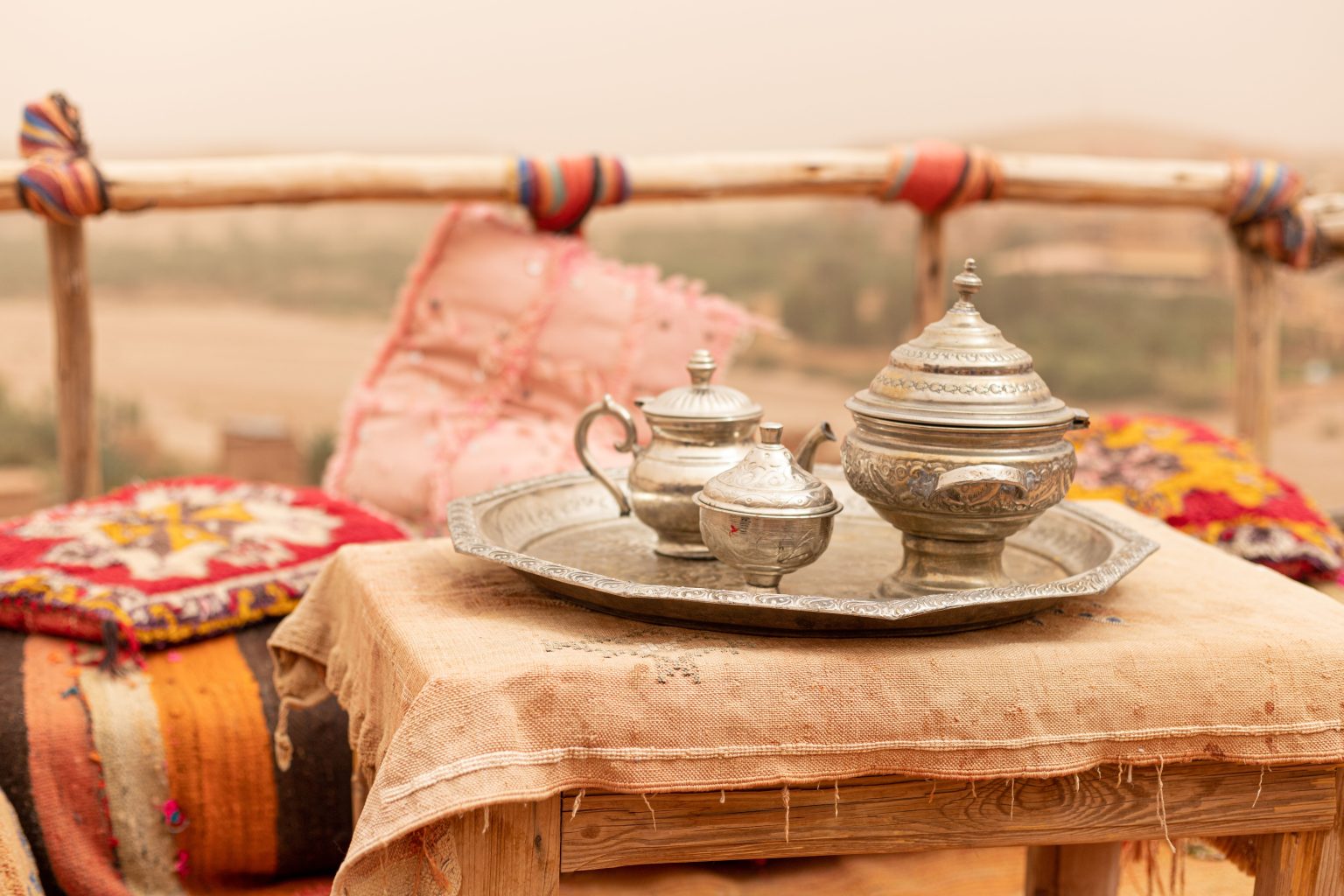
Mid morning you stop at a nomad family camp. They keep goats, they move twice a year, and the tent is made of woven black goat hair that stays cool at forty degrees. You sit on the rugs, tea is made in front of you, and the conversation happens through your driver. There is no craft table at the exit and nothing is for sale. We pay the family a fixed fee for the visit.
In the afternoon you drive to Khamlia, a village settled by descendants of people brought north along the caravan routes from Mali and Sudan. The gnawa musicians there play with iron qraqeb castanets and a three string guembri over a deep, slow pulse that is closer to West Africa than to anything else in Morocco. You sit with them in a low room, they play a full set, and there is tea and peanuts afterwards. Back at camp, dinner and a sky with no light pollution for three hundred kilometres.
You watch the sunrise from a dune above camp, have breakfast, and then leave the erg westward on a road nobody took on the way in. First Rissani, the market town built on the ruins of Sijilmasa, where caravans from Timbuktu once unloaded gold and salt, and where the Alaouite dynasty that still rules Morocco began. The souk here is agricultural and unpolished, and on market days it is one of the most photogenic in the country.
From Rissani the road runs west across the hamada, a flat black stone desert broken by the occasional line of khettara wells, to Alnif, a small town under a jagged ridge that trilobite hunters have made half famous. The emptiness of this stretch is the point. There are two hours where you pass almost nothing at all, and that is a rarer experience than any monument.
The land softens as you reach the Draa, where a single river feeds a corridor of date palms hundreds of kilometres long with kasbahs set along it. By late afternoon you are climbing into the Dades valley, past the rock formations locals call the monkey fingers, to the Eden Boutique Hotel, a small house on the valley side with a terrace that catches the last light on the red cliffs.
Before turning west we drive the first few kilometres up into the Dades gorge itself, where the road does a famous set of hairpins up a cliff face and the canyon narrows to a slot. An hour here in the morning light, with almond trees on the valley floor and villages built into the rock, is worth the early start.
The drive back crosses Skoura, where we stop in the palm grove and walk ten minutes to a working kasbah, then Ouarzazate and up over the Tichka pass again. Coming from this direction the Atlas is a completely different mountain, green on the northern slopes and much steeper, and Marrakech appears below you in the plain in the late afternoon.
You are back at El Fenn by early evening with your luggage waiting and a room already made up. The evening is yours. Most people want a hammam and a quiet dinner on the roof rather than another walk, and we will have that arranged if you tell us in advance.
A last morning shaped around your flight. If you leave late we take three hours in the medina with a private guide, which is enough for the Ben Youssef madrasa, the Saadian tombs and a workshop or two, or enough for a proper run at the souk if you have a list. If you leave early, breakfast on the roof and a quiet car to the airport.
Anything you bought along the way that will not fit in a case, a rug from Tinghir or fossils from Erfoud, we will have arranged shipping for before you leave. Your driver takes you to Menara and walks you as far as the terminal doors.
Four Houses,Each Chosen for Its Hour
We do not use a chain anywhere on this Luxury Sahara Desert. Each of these is a house with an owner, chosen because it sits exactly where the driving should stop and because the room you get is one we have slept in ourselves.
A run of old medina houses joined around five courtyards, with a serious contemporary art collection on the walls, a heated pool, a hammam, and a roof terrace with a full view of the Koutoubia. It is five minutes on foot from the Jemaa el Fnaa and completely silent once the door closes. We ask for a room on the upper floor with its own terrace.
The established address in Ouarzazate, a low building set in gardens with a large pool, which after five hours in the car is the single most welcome thing in southern Morocco. Rooms are generous and cool, the dinner is good, and it is ten minutes from the Taourirt kasbah if you want to see it lit at night.
A permanent camp set among the dunes with tented suites that have real beds, rugs, an ensuite bathroom with a hot shower, and electricity through the night. There are no other camps in sight and no vehicles once you arrive. Dinner is served outside, breakfast comes to you at whatever hour you surface.
A small hotel on the side of the Dades valley, built in local stone and earth, with a terrace that looks straight down the gorge. Fewer than twenty rooms, a fire in the lounge in winter, and a kitchen that cooks what the valley grows. The quietest night of the Luxury Sahara Desert after the desert.
Every property above is the one we book first. If your dates are full we name the exact alternative in writing before you pay anything, always at the same standard or better.
What This Luxury Sahara DesertActually Costs
We quote every journey individually because the number moves with your dates, the size of your party and the standard of room you want. What follows is the honest range rather than a headline figure designed to get you on the phone.
The single biggest lever is how many of you travel. A private driver and vehicle cost the same for two people as for six, so a group of friends or a family gets considerably more journey per euro than a pair does. High season, which here means October, November, March and April, adds roughly fifteen percent.
Send us your dates and we come back within 24 hours with a fully costed itinerary, named properties, and no obligation whatsoever.
Typical guide price
Included in the price
- Six nights in the houses named above, in the room category we specify
- Private four wheel drive vehicle and English or French speaking driver for the whole route
- All breakfasts, plus dinner at Ouarzazate, both nights in the desert camp and the Dades valley
- Camel ride into the erg at sunset and the four wheel drive desert circuit
- The nomad family visit and the gnawa session at Khamlia, paid at a fair fixed rate
- Licensed local guides at Ait Ben Haddou and in Marrakech
- Airport transfers both ways and all fuel, tolls and parking
Not included
- International flights and travel insurance
- Lunches and the two dinners in Marrakech
- Hammam and spa treatments, which we book on request
- Anything you buy in a souk or workshop
- Tips for your driver and guides, at your discretion
What to Expect on This Luxury Sahara DesertBefore You Commit
How Much Driving, Honestly
Two days involve five to six hours behind the wheel and three days involve two hours or less. The vehicle is a comfortable four wheel drive with air conditioning, we stop every ninety minutes, and the roads are tarmac the whole way apart from the desert circuit. If long drives are truly a problem for someone in your party, tell us and we will add a night at Skoura to break it.
Weather and the Right Months
October to April is the season. Daytime in the desert is pleasant from twenty to twenty eight degrees, and nights drop sharply, often close to freezing in January, which is why the camp has heavy blankets and hot water bottles. May and September are hot but workable. We do not run this Luxury Sahara Desert in July and August, when Erg Chebbi regularly passes forty five degrees.
What to Pack for the Camp
One small bag for the two desert nights, since camels carry it in and space is limited. A warm layer for the evening whatever the month, closed shoes for the dunes at night, a scarf for wind, and a torch. Leave the large case at El Fenn in Marrakech, which is why we bookend the Luxury Sahara Desert there.
Physical Requirements
Easy. There is no trekking. The most demanding moments are a forty minute camel ride, a twenty minute climb through Ait Ben Haddou, and walking on soft sand near the camp. Camels can be replaced with a four wheel drive transfer into the camp at no extra cost if anyone prefers, and we do this often.
Children and Families
This Luxury Sahara Desert works well from about age seven upward, and children usually remember the camp for years. Below seven the driving days are hard. We can fit child seats, shorten the two long days by adding a night, and the camps will put an extra bed in a family tent.
Making It Longer or Shorter
The natural extensions are a night at Skoura in the palm grove, two nights in Essaouira on the coast at the end, or a night in the Ourika valley in the Atlas before you fly. The route can also be compressed to five days by cutting the Dades night, though we would rather you cut the Luxury Sahara Desert than cut the second desert night.
Luxury Sahara Desert Questions We AreAsked Most Often
They Travelled With Us
Mohammed had the talent to make us approach beautiful sites, far from places a little too touristy. He tells us with passion, humor and knowledge about his beautiful country. A true storyteller.
A 3rd unforgettable experience in the Moroccan desert! Mohamed is a very professional guide who knows how to adapt to the group and remains attentive to the needs of each with kindness.
The five day ascent of Mount Toubkal was a real dive into the heart of the Atlas and its communities. Accompanied by Mohamed, his muleteers and his cook, we lived a total immersion in this region with respect for all.
Two Nights in the SaharaInstead of One
Send us your dates and the number of you travelling, and we will come back within 24 hours with a fully costed version of this Luxury Sahara Desert, the exact rooms we would hold, and the alternatives if anything is full.